Introduction
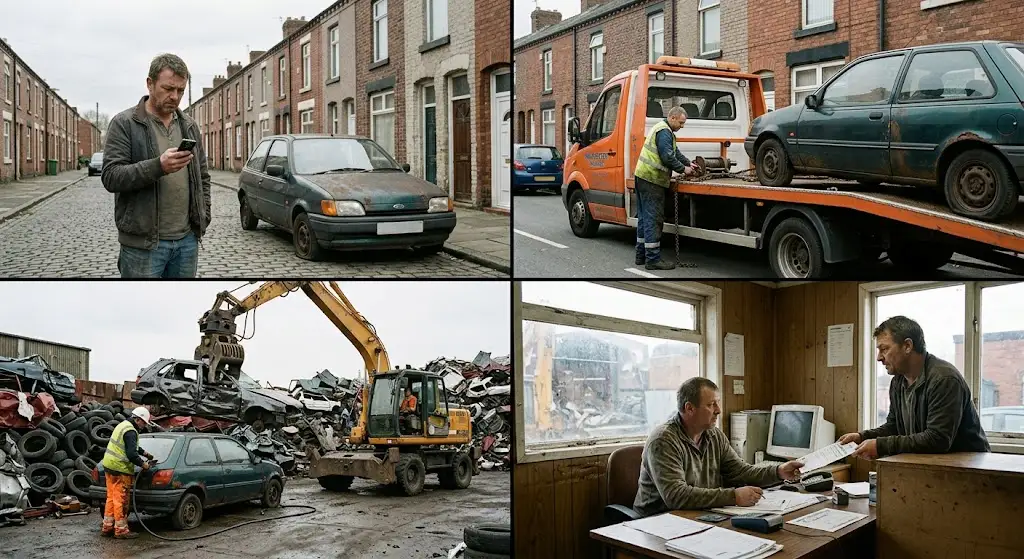
If you are wondering How to Scrap My Car in Manchester UK, the process is straightforward when you use an authorised treatment facility (ATF). How to Scrap My Car in Manchester UK starts with finding a licensed facility, getting a quote, arranging collection or delivery, and preparing your vehicle documents. GOV.UK states that vehicles should be scrapped through an authorised treatment facility, and you should give the ATF your V5C log book while keeping the yellow section.
In this guide, we explain How to Scrap My Car in Manchester UK step by step, including choosing a reputable scrapyard, checking payment arrangements, removing personal belongings, and notifying DVLA. If the car is completely scrapped, the ATF should provide a Certificate of Destruction, normally within seven days.
At scrapmycaruk.com, we simplify the entire vehicle scrapping journey for Manchester residents, providing instant quotes, free collection, and professional DVLA handling. Our service covers all ten boroughs including Bolton, Bury, Oldham, Stockport, Salford, and surrounding areas. The process typically takes just a few days from initial contact to receiving your payment.
What You Need Before You Start
Before initiating your scrap car quote, gather the following essential documents to streamline the process:
Your V5C logbook remains the most important document. This vehicle registration certificate confirms your ownership and provides the DVLA with vehicle details. Furthermore, you’ll need a valid photo ID such as a passport or driving licence, plus proof of your current address through a utility bill or council tax statement. Additionally, if your vehicle registration number differs from your current records, updated documentation proves beneficial.
Insurance papers aren’t required, nor do you need your MOT certificate or service history. Similarly, you don’t need to provide proof that the vehicle runs or maintains roadworthiness. In fact, many scrapping companies accept vehicles that won’t start, have failed MOTs, or suffer from significant damage.
Step 1: Get Your Scrap Car Quote
The first stage involves obtaining an accurate instant quote tailored to your vehicle. Contact your chosen vehicle recycling specialist through their website or telephone number. Most providers offer rapid online quote systems requiring only basic vehicle information.
Enter your vehicle registration number, make, model, and year of manufacture. Following this, describe the condition honestly, including any damage, mechanical issues, or missing components. Your quote depends on several key factors: current scrap metal prices, your vehicle’s weight, condition, make and model, and whether parts remain intact. Metal market values fluctuate regularly, so quotes typically remain valid for a specific period, often between seven and fourteen days.
Reputable companies never charge cash payment for vehicles. The Scrap Metal Dealers Act 2013 legally prohibits cash transactions. Instead, all payments transfer directly to your bank account via secure bank transfer, providing full traceability and protecting both parties.
Step 2: Book Your Collection
Once you accept your quote, the next phase involves scheduling a convenient collection appointment. Most vehicle collection services offer flexible booking options including same-day or next-day appointments depending on availability and your location within Greater Manchester.
Communicate your vehicle’s location clearly. Provide details about whether your car sits on a private driveway, within a garage, on a private road, or in a flat car park. Similarly, mention any access restrictions such as narrow gates, tight parking spaces, or security barriers. Professional removal teams bring appropriate equipment to handle vehicles in challenging locations, whether at ground level or elevated positions.
You’ll receive confirmation of your collection date and expected time window. Most appointments occur within a 2-4 hour timeframe. Additionally, ask about payment timing. Reputable operators issue payment on the collection day before the driver departs, ensuring immediate bank transfer to your account.
Step 3: Prepare Your Car
Preparation makes the collection process smoother and faster. Remove all personal belongings from the interior, including items hidden in the glove box, door pockets, and under seats. Additionally, check the boot thoroughly for personal possessions. Empty the fuel tank as much as possible, since safety regulations restrict transporting vehicles with significant fuel levels.
Locate your V5C logbook and keep it readily accessible for collection day. If you’ve misplaced this document, don’t worry, though the process becomes slightly more involved. Have your photo ID and proof of address available for identity verification. The collection driver performs standard ID checks as part of the authorised treatment facility protocols, protecting against fraud and ensuring compliance with vehicle disposal regulations.
Furthermore, remove any number plates if you wish to retain them for future use. However, note that retaining plates must occur before the Certificate of Destruction is issued, since once scrapped, number plates cannot be reassigned. Contact the DVLA to arrange number plate retention if desired.
Step 4: Collection Day
When the collection team arrives, they perform a vehicle inspection confirming the condition matches your quote description. The driver verifies your identity against your V5C and photo ID. Subsequently, you receive your payment, typically processed immediately as a bank transfer. The payment appears in your account within one to three business days, though most banks process transfers the same day.
The collection team loads your vehicle onto their flatbed lorry using professional equipment. Ensure no personal items remain inside the vehicle. After the vehicle is secured, the driver provides you with documentation confirming the collection date and vehicle removal. Keep this paperwork safely, as it serves as evidence should questions arise later.
At this stage, your involvement in the physical aspect ends. However, you still maintain responsibility for notifying the DVLA until the Certificate of Destruction is officially issued and processed.
Step 5: Receive Your Payment
Your bank transfer payment arrives within the timeframe specified during booking. Most reputable operators complete payments on collection day. Track the transfer through your banking app or contact your provider’s customer service with your payment reference number if delays occur beyond three business days.
Save your payment confirmation alongside your collection paperwork. Combined together, these documents provide evidence of the transaction should the DVLA require clarification. Similarly, retain your bank statement showing the credit for record-keeping purposes.
Step 6: Notify DVLA
Informing the DVLA represents a crucial legal requirement after your vehicle is collected. Failure to notify the DVLA within the specified timeframe can result in fines up to £1,000 and continued road tax charges on your name.
If you retained your V5C, complete Section 9 of the document. This yellow slip already contains relevant information and requires only your signature and the collection date. Post this to the DVLA address shown on your logbook. Alternatively, notify the DVLA online through their official website by entering your 11-digit V5C document reference and vehicle registration number.
If the authorised treatment facility retained your full V5C, they’ll notify the DVLA directly on your behalf. However, confirm this arrangement beforehand, since some facilities require additional paperwork completion.
Step 7: You Receive the Certificate of Destruction
The Certificate of Destruction, commonly shortened to CoD, represents your official proof that the vehicle underwent proper scrapping procedures. The DVLA issues this document following notification from the end-of-life vehicle recycler. Typically, you receive your CoD within seven business days of the DVLA receiving scrapping notification.
This certificate holds tremendous importance. Additionally, keep it indefinitely in a safe place, as it proves you no longer hold responsibility for the vehicle. Should the DVLA query your vehicle’s status in future years, this document provides definitive evidence of proper disposal.
The CoD details the vehicle registration number, DVLA reference, and destruction date. Furthermore, it confirms that the vehicle underwent treatment through approved facilities following environmental regulations and the ELV directive requirements.
What Happens to Your Car After Collection?
Following collection, your vehicle travels to a licensed authorised treatment facility where comprehensive processing occurs. Initially, the vehicle undergoes de-pollution, where fluids including engine oil, coolant, and brake fluid get safely drained and disposed of according to environmental standards. This crucial step prevents hazardous materials from contaminating soil or waterways.
Subsequently, the vehicle moves into the dismantling phase. Skilled technicians remove usable components including engines, gearboxes, doors, and electronic systems. These parts enter the salvage market for reuse in other vehicles, extending their lifecycle and reducing demand for new manufacturing. Following parts removal, the remaining vehicle shell proceeds to crushing and shredding machinery that reduces the metal into manageable pieces.
Finally, metal recycling specialists separate ferrous metals, aluminium, and other materials for reprocessing. This recycled material feeds back into manufacturing industries, reducing mining requirements and environmental impact. The entire process operates under strict environmental compliance regulations, ensuring nothing goes to waste.
How Long Does the Whole Process Take?
The complete scrapping timeline varies depending on several circumstances. From obtaining your initial quote to receiving payment typically spans two to seven days. Numerous variables influence speed, including your location within Greater Manchester, your vehicle’s accessibility, and booking availability.
Following collection, DVLA notification takes approximately two to four weeks for processing. The Certificate of Destruction arrives within seven business days of the DVLA confirming scrapping notification. Consequently, the entire process from initial contact to receiving your CoD typically completes within three to five weeks.
Expedited services sometimes arrange same-day collection in emergency situations. However, standard operations provide sufficient timeframe for most circumstances.
Frequently Asked Questions
Can I scrap a car that is not in my name?
Technically, the registered keeper shown on the V5C logbook must authorize the scrapping. If the vehicle belongs to a family member, obtain their written consent and include relevant identification documentation during collection.
Do I need to insure the car before scrapping it?
No insurance coverage is necessary once the vehicle stops being used on public roads. However, if your vehicle remains on a private driveway awaiting collection, maintaining insurance provides coverage against theft, vandalism, or accidental damage while stored on your property.
What if my car is an insurance write-off?
Insurance write-offs can proceed to scrapping normally. Inform your scrap car service provider of the write-off status when obtaining your quote, as this might affect valuation. The insurer typically already owns such vehicles, so ensure they authorize scrapping before proceeding.
Can I scrap a SORN car?
Yes, vehicles with Statutory Off Road Notification status can be scrapped without complications. SORN cars don’t require insurance during the collection process since they’re legally off the road. Most collection services handle SORN vehicles regularly without additional charges or complications.
What if my car is on a private road or stuck in a garage?
Accessibility isn’t an obstacle for professional collection teams. Whether your vehicle is on a narrow private road, within a garage, or parked in difficult positions, removal specialists bring appropriate recovery equipment. Simply communicate access details when booking, allowing technicians to prepare suitable vehicles and tools.
Will I still get paid if the car is in bad condition?
Vehicle condition absolutely affects valuation, yet even severely damaged cars retain scrap value based on weight and metal content. Non-runners, vehicles missing engines, and cars with extensive rust still command payment. Your quote reflects the actual condition you describe, so honesty ensures accurate pricing without valuation surprises during collection.
What if I’ve lost the keys to the vehicle?
Missing keys don’t prevent scrapping, since your vehicle travels via flatbed lorry rather than being driven. The collection team uses appropriate methods to load vehicles without requiring engine operation. Simply inform your scrap car provider about missing keys when booking.
Can I still keep my number plate if I’ve already booked a collection?
Retaining number plates requires action before collection. Apply through the DVLA to retain your registration number, which assigns it to a retention certificate. Once the Certificate of Destruction is issued, retaining plates becomes impossible. Contact the DVLA immediately if you wish to keep your number.
Comparison Table: Manchester Scrap Car Service Standards
| Service Feature | Standard Expectation | Premium Level |
| Quote Provision | Online within minutes | Instant phone quote available |
| Collection Speed | 3-7 days from booking | Same-day to next-day options |
| Vehicle Accessibility | Standard locations covered | Difficult access locations handled |
| Payment Method | Bank transfer only | Bank transfer, occasionally same-day |
| DVLA Handling | Service manages notification | Full DVLA paperwork included |
| Collection Cost | Completely free | No hidden charges guaranteed |
| Certificate Issue | 7 days standard | Expedited options available |
Key Manchester Scrap Car Providers
Selecting a reputable vehicle recycling company ensures proper treatment of your vehicle and reliable payment. Manchester residents benefit from several licensed authorised treatment facilities operating across all ten boroughs. Research providers thoroughly, checking customer reviews, verifying DVLA licensing, and confirming insurance write-off handling capabilities.
Final Recommendations for Manchester Residents
Before finalizing your decision, obtain multiple quotes from different providers. Market rates fluctuate based on metal prices, so comparing offers ensures maximum value. Additionally, verify that your chosen company is DVLA-licensed, can handle your vehicle’s specific circumstances, and provides free collection without surprise charges.
Prepare your documentation well beforehand, gathering your V5C logbook, photo ID, and proof of address. Clear communication about your vehicle’s location prevents collection complications. Additionally, confirm payment arrangements and DVLA notification procedures in writing.
Finally, retain all documentation including your collection paperwork, payment confirmation, and eventually your Certificate of Destruction. These records protect you against future DVLA inquiries and provide proof of proper vehicle disposal.
Scrapping your car in Manchester ultimately represents a responsible environmental choice. Through licensed facilities, your vehicle’s materials enter recycling streams, reducing manufacturing demands and environmental impact. The process itself remains straightforward when you partner with reputable providers like scrapmycaruk.com, ensuring compliance with regulations while maximizing your financial return.
Contact your chosen scrap car Manchester service provider today to arrange your vehicle’s collection and receive instant payment for your unwanted vehicle. The process takes minimal effort on your part while delivering environmental benefits and immediate cash payment.